save the Blue Tier
tasmanian liverworts - unidentified
unidentified (2010/10/08)
Unable to identify this liverwort so far but the hyaline margin cells, deeply concave unlobed leaves hiding the stem, lack of obvious underleaves and the large size (3mm width) should produce some candidates before long.
Tasmanian records for Gymnomitriaceae include monotypes of Gymnomitrion, Herzogobryum, Marsupella and Nothogymnomitrion, all of which had to be rejected for various reasons. The other possibiity is Calyptrocolea sp. (formerly Adelanthus).

1. Plants growing on shallow soil over rock
Notes
- growing on shallow soil pocket on an exposed mountain outcrop with little plant cover; vascular plants nearby include Notelaea ligustrina, Monotoca glauca & Oxylobium arborescens.
- plants erect without branching above ground; width: ~3mm; leaves over 2 mm wide, deeply concave adaxially, imbricate; leaf arrangement incubous, alternate, facing each other across stem; length to width ratio approaching 2:3 with wide basal attachment to around half of fleshy stem; underleaves not apparent
- pix 2 shows a leaf under cover glass - despite tearing apart of leaf, sector with tooth on the ventral side is folded over on the right in pix
- one to several layers of margin cells hyaline near the tooth (ventral side) but reducing to single hyaline margin cells away from tooth (pix 4); where not empty 2-3 smaller oil bodies in border cells positioned away from margin
- each leaf has a large tooth comprising of 6-8 cells on the ventral side; some leaves have an additional smaller tooth of 2 cells on the dorsal side (pix 5)
- cells isodiametric 30-40 um across with 2-4(-5) large botryoidal (?) oil bodies up to 20 um long occupying much of the cell lumen (pix 3); small trigones present; leaf cells near point of attachment are unistratose around 35 um thick (pix 6)
- underground structure not examined; reproductive organs not visible
 2. leaf (partly folded) |
 3. cells mid-leaf |
 4. hyaline margin cells |
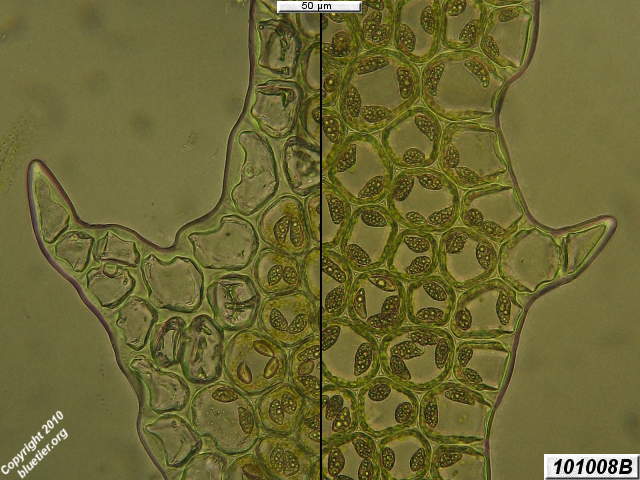 5. margin teeth |
 6. leaf cells TS |